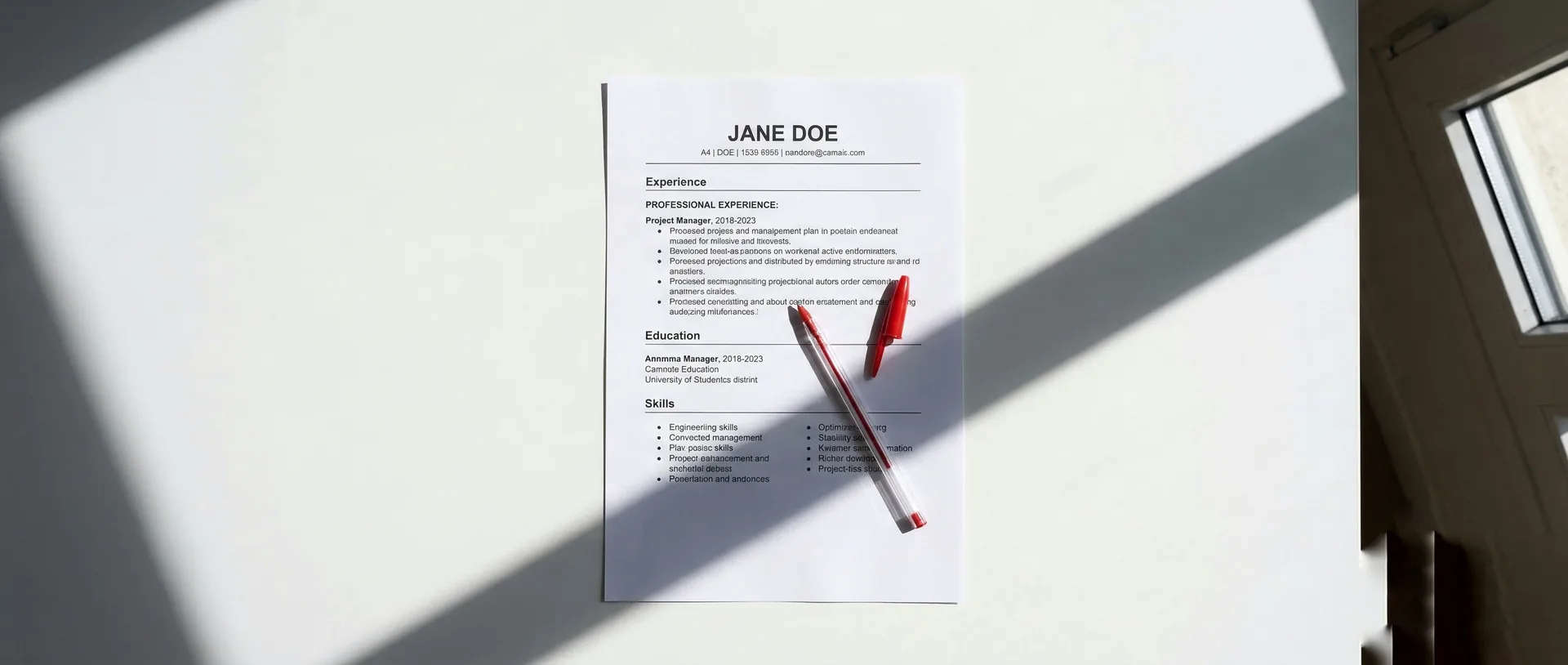
We read a lot of CVs. Hundreds of them every year. And we say this with love, not criticism — many of them could be better. Not because the teachers behind them aren't good teachers. Often they're exceptional. But a weak CV can cost you a great placement before anyone has even had the chance to meet you. We don't want that to happen to you.
So let us be honest with you about what we see — the mistakes that come up again and again — and what we'd want you to fix before you submit.
Too much information.
We know you've done a lot. We know you want us to see all of it. But a CV that tries to include everything ends up communicating very little. When everything is highlighted, nothing stands out.
Focus on the most relevant parts of your experience — the last ten to fifteen years, the positions most closely related to what you're applying for, the achievements that actually demonstrate your capability. Keep it clean. Keep it focused. Less, genuinely, is more.
A CV is not a life history. It is an invitation to a conversation. Write it that way.
Fonts that get in the way.
We have seen CVs in fonts that look like they belong on a birthday invitation. We have seen CVs where the text is so small it requires reading glasses. We've seen colour choices that make a document practically unreadable when printed.
Your CV will be read quickly — often in under two minutes on a first pass. Make it easy. A clean, readable font at a comfortable size. Consistent formatting throughout. The design of your CV should never distract from its content.
Buzzwords that don't say anything.
Strategic thinker. Dynamic educator. Hardworking and detail-oriented. These phrases appear on so many CVs that they have lost all meaning. They tell us nothing about you specifically. They are the CV equivalent of wallpaper.
Replace them with specific, concrete examples. Instead of "dynamic educator," tell us about a particular project or approach you used that achieved a measurable result. Instead of "hardworking," show us the evidence. Specificity is far more convincing than adjectives.
Errors that signal carelessness.
A spelling mistake or grammar error in a CV tells the reader something — not that you're unintelligent, but that you didn't care enough to check carefully. For a teacher, whose work centres on communication and precision, this creates an uncomfortable impression.
Proofread your CV. Then give it to someone else to proofread. Then read it again. Use a tool like Grammarly if it helps. This is the document that represents you before you get to speak for yourself — it needs to be right.
The wrong order.
There is a logical flow to a strong CV: contact details, a brief professional summary, qualifications, work experience (most recent first), relevant skills, references available on request. When this order is disrupted — when qualifications appear after experience, or when the most important information is buried on page two — it creates confusion and costs you attention you can't afford to lose.
If you're not confident about your CV and would like a set of experienced eyes on it, talk to us. We've helped many teachers strengthen their applications before submitting them. It's part of how we look after the teachers we work with.
Your CV is not a formality. It is your first chance to make us believe in you. We want to believe in you. Help us do that.
— The Eduplace Family