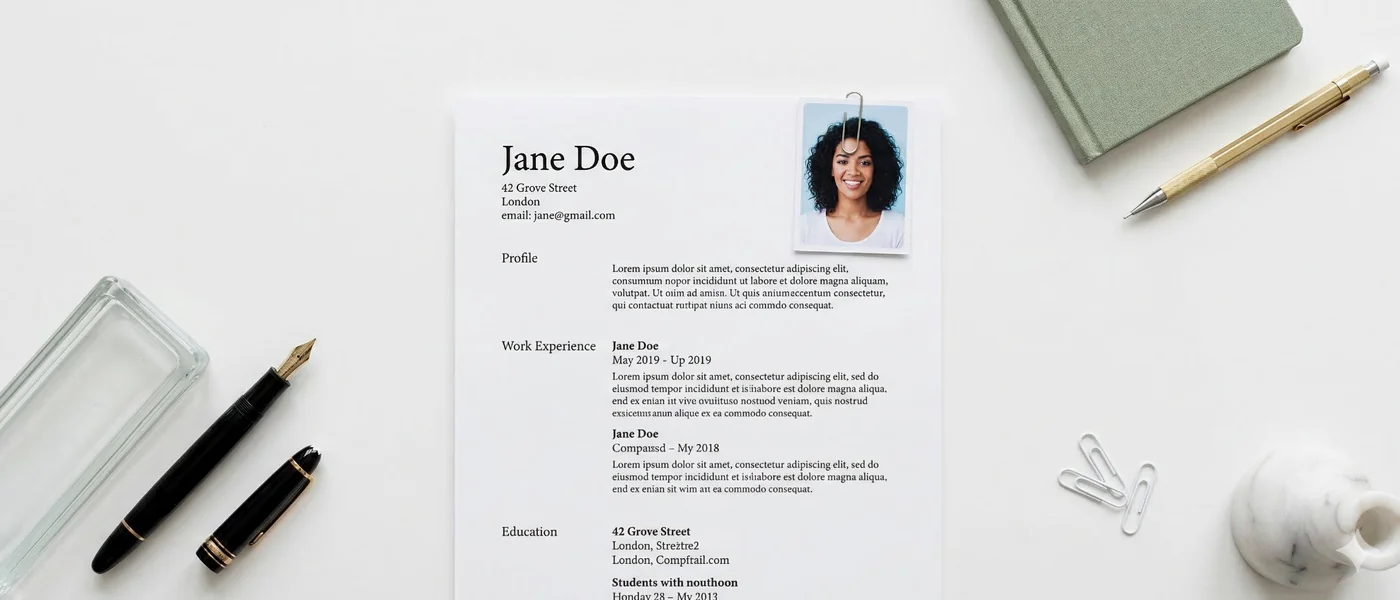
It's a question we get asked regularly, and it's one where the advice varies so wildly depending on who you ask that teachers often end up more confused than when they started. So let us give you our honest, experience-based answer — the answer we'd give our own child sitting across the table from us.
Whether to include a photo on your CV depends almost entirely on where you're applying and who is reviewing it. There is no single universal answer. But there are clear principles — and once you understand them, the decision becomes straightforward.
For South African applications — generally no.
In South Africa, the convention for most professional applications — including teaching positions — is to submit a CV without a photo. This aligns with employment equity principles and anti-discrimination legislation. Including a photo can actually create an uncomfortable situation for a hiring manager who is trying to make unbiased decisions. You are not helping yourself by including one. You may even be creating an unintended complication.
Leave the photo out for local applications unless the school or institution explicitly requests one.
For international applications — it depends on the country.
This is where it becomes more nuanced. In many Middle Eastern countries, a professional photograph is standard and expected on a teaching CV. Schools in the UAE, Kuwait, Qatar, and Saudi Arabia often request a recent photo as part of the application. In these contexts, not including one can work against you — it can make your application feel incomplete.
For European applications, the convention varies significantly by country. Germany and Austria expect photos. The UK and most English-speaking countries prefer not to receive them. Know your market before you decide.
A photo is not decoration. In the contexts where it is expected, it is part of your professional presentation. Get it right.
If you do include a photo — it must be professional.
We have seen photographs on CVs that have genuinely hurt an application — not because of the person's appearance, but because of the photograph itself. Casual selfies. Holiday photos cropped to remove the surrounding people. Low-resolution images taken in poor lighting. These things communicate carelessness, and carelessness is the last impression you want to make.
If you are applying to markets where a photo is expected, invest in a proper professional headshot. Good lighting, a plain background, professional dress, a natural expression. It does not need to be expensive. A good camera, good light, and a trusted friend can achieve this. But it needs to look like you took the application seriously — because you did.
South Africa: No photo unless specifically requested.
UAE, Kuwait, Qatar, Saudi Arabia: Include a professional headshot.
UK, Australia, USA: No photo — it is not expected and may be viewed negatively.
Germany, Austria, parts of Europe: Photo is expected and standard.
When in doubt — ask us. We know what the schools we work with expect, and we'll tell you exactly what to include.
The details matter more than people realise. A CV that reflects care, thought, and appropriateness for its audience signals exactly the kind of professionalism that schools are looking for in a teacher. Get the small things right — and the important things follow.
— The Eduplace Family